

When you’re mixing dry powders, granules, or other particulate materials, the Double Cone Blender Mixer is one of the most reliable workhorses in industries from pharmaceuticals to food processing. As a supplier that’s helped hundreds of manufacturers find the right mixing solutions, I can tell you that one of the most common questions we get is: “How do I select the appropriate blade or agitator for my double cone blender?” The answer isn’t one-size-fits-all—choosing the wrong blade or agitator can lead to uneven mixing, product degradation, extended cycle times, or even wasted material. Let’s break down the key factors to consider, so you can make a choice that works for your specific application.
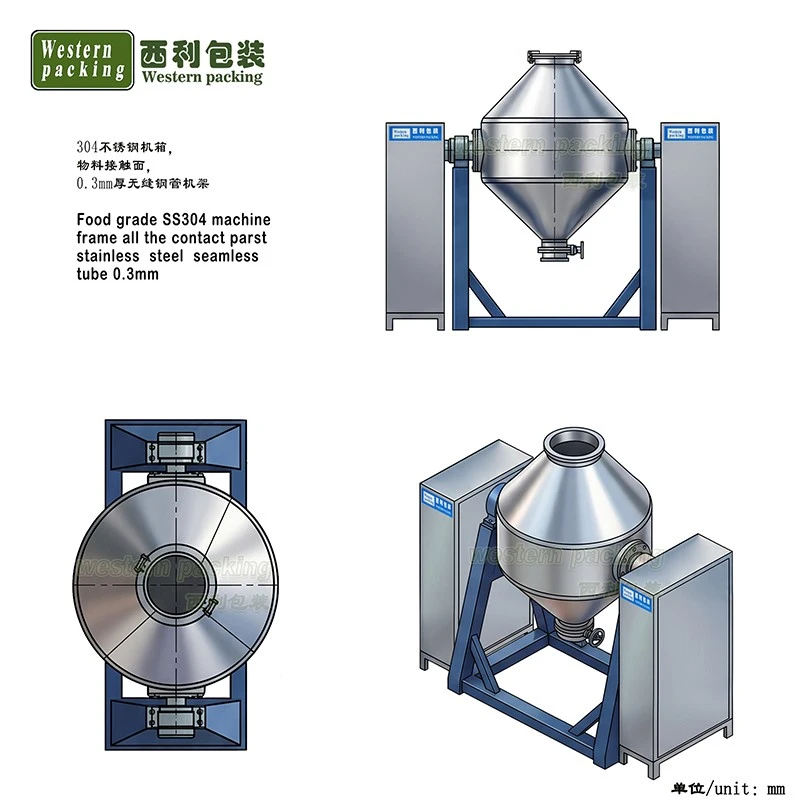
First, let’s start with a quick recap of what a double cone blender does. Unlike some mixers that use high-shear impellers, a basic double cone blender relies on the gentle tumbling of two connected cone-shaped ends that rotate along a horizontal axis. This tumbling action causes materials to move from one end of the cone to the other, creating a homogeneous mixture over time. For many low-viscosity, free-flowing materials, this tumbling alone is enough. But when you’re working with materials that are cohesive, hard to blend, or prone to separating, you’ll need to add internal components—blades or agitators—to enhance the mixing action.
The first step in selecting the right blade or agitator is to define your material properties. This is non-negotiable. Let’s go over the most common material characteristics that drive your component choice. If your materials are free-flowing granules—think sugar, salt, or certain pharmaceutical excipients—you might not need any internal parts at all. The natural tumbling of the Double Cone Blender Mixer will move these particles evenly without assistance. But if your materials are cohesive—like flour, powdered milk, or fine drug powders that clump together—or have a wide range of particle sizes that tend to separate (a problem called segregation), you’ll need something more.
Cohesive materials stick together, so the tumbling motion alone isn’t enough to break up clumps and distribute them throughout the batch. Segregation happens when smaller, lighter particles rise to the top or larger, heavier particles settle at the bottom during mixing, which ruins consistency. For these issues, a simple blade or agitator can help. The type of blade or agitator depends on how cohesive your material is and how large your batch is.
Next, consider your mixing goals. Are you looking for gentle blending to avoid damaging fragile particles? Or do you need a bit of force to break up agglomerates? For example, if you’re mixing food ingredients—where product integrity, texture, and safety are top priorities—a Food Double Cone Mixer with a low-shear blade is ideal. High-shear components could crush delicate particles or create excess heat, which would ruin the quality of food products or sensitive pharmaceuticals. A low-shear blade fits loosely in the double cone, so it breaks up small clumps without damaging particles, making it perfect for food-grade materials that need to maintain their natural properties.
On the other end of the spectrum, if you’re working with extremely cohesive powders that form hard agglomerates, you’ll need a more aggressive agitator. A paddle-style agitator with curved blades that reach close to the walls of the double cone can scrape clumps off the interior surface and force them back into the moving batch. This type of agitator is often used in pharmaceutical applications where active pharmaceutical ingredients (APIs) need to be evenly distributed with excipients, even when the API is present in very small quantities (like 1% or less of the total batch). For these “dilute mixing” applications, the agitator ensures the API doesn’t just stay in one clump—something that’s critical for product efficacy and regulatory compliance.
Batch size is another critical factor. If you’re running small batches (under 50 liters), a small internal blade might work well, but if you’re mixing 1,000-liter batches, you need an agitator that can cover the entire volume of the cone. A too-small agitator won’t reach the outer edges of the batch, leaving areas that are under-mixed. This is especially important when you’re working with materials that have a tendency to pool in the corners of the double cone during rotation. For example, if you’re mixing grains or coarse granules, a Cone Blender Mixing Powder and Grain with a diameter-adjustable agitator can adapt to both small and large batch volumes, ensuring every particle is moved consistently regardless of how much material is in the cone.
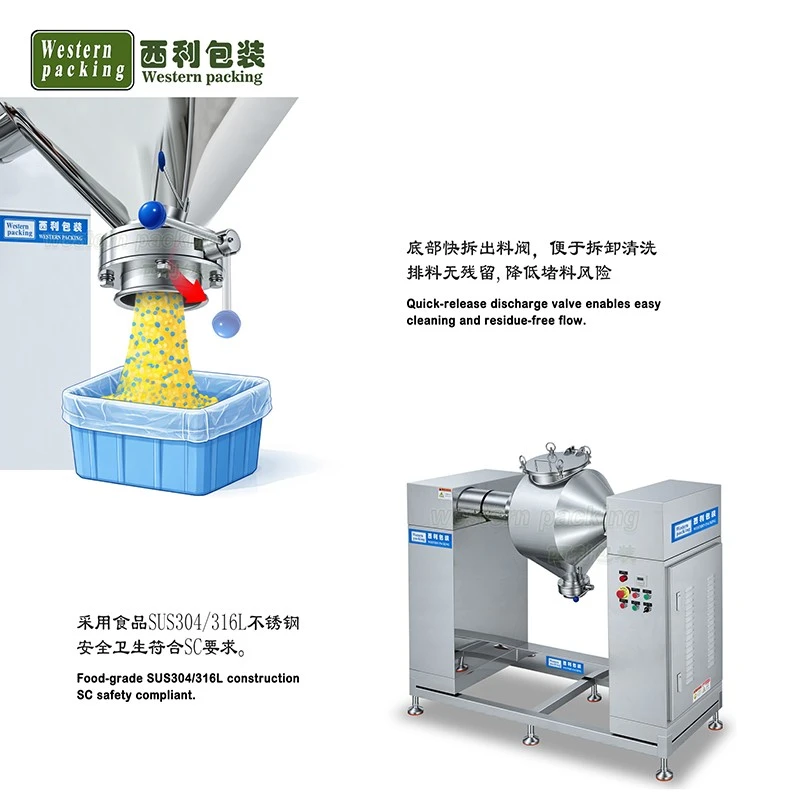
You also need to think about how your mixer is loaded and unloaded. Some blades are designed to stay out of the way during discharge, while others might create dead zones where material gets trapped. For applications where quick, complete discharge is necessary (to avoid cross-contamination between batches, for example), a semi-flexible blade that folds back when the cone is inverted is a good choice. This way, there’s no blade sticking into the discharge path, so 100% of the material flows out—something that’s a must for industries that switch between different formulations frequently, like contract manufacturing.
Wait time is another practical consideration. How long are you willing to run the mixer to get a uniform blend? Internal blades and agitators can significantly reduce mixing time by speeding up particle circulation. If your current mix process takes 30 minutes, adding the right agitator might cut that to 15 minutes, which saves energy and increases your production output. But there’s a trade-off: adding an agitator isn’t free, and it adds complexity to the mixer (you have to clean it, maintain it, and make sure it’s compatible with your cleaning processes). For that reason, if your materials mix quickly with just the tumbling action, it’s better to skip the blades entirely to save on cost and cleaning time.
Let’s talk about common mistakes I see customers make. One of the biggest is using a high-shear blade on a fragile material. Last year, a customer came to us with a problem: they were mixing a powdered probiotic (which is very sensitive to heat and particle damage) in a standard double cone blender. The blending process was killing 20% of the probiotic, so they switched to a high-shear agitator thinking it would mix faster—but that made the problem worse. We suggested a low-shear, flat blade that moved particles without generating friction, and that cut the probiotic loss to less than 2%. It’s a small detail, but it makes all the difference for sensitive products.
Another mistake is not testing the blade or agitator with their actual material. Every powder is different—what works for one cohesive material might not work for another. That’s why we always recommend a test in our facility before a customer buys a full unit. We can set up the Mixing Double Cone Blender with different blade configurations and test your material to see which one gives you the best homogeneity, shortest cycle time, and lowest product degradation. This avoids the hassle of buying a blade that doesn’t work and having to modify or replace it later.
Maintenance is also something to keep in mind. Blades and agitators have moving parts, so they need to be lubricated, inspected, and cleaned regularly. For applications that require CIP (clean-in-place) capabilities—like food and pharmaceutical production—you need a blade that’s easy to remove and sanitize. Some agitators have sealed bearings that can be cleaned in place, while others require full disassembly. The latter is fine for low-production, small-batch operations, but for high-volume facilities running 24/7, CIP-compatible components are non-negotiable.
Let’s summarize the steps to make your selection: First, test your material’s properties: is it free-flowing, cohesive, fragile, or prone to segregation? Second, define your mixing goals: gentle blending, aggressive clump breaking, or rapid mixing for large batches. Third, consider batch size and discharge requirements. Fourth, factor in maintenance and cleaning needs. Fifth, don’t forget to test before you buy.
At the end of the day, the right blade or agitator turns a good double cone blender into a great one. It’s the difference between a blend that meets your quality standards and one that costs you time, money, and product. If you’re not sure where to start, our team is here to help. We can walk you through our range of double cone blenders, show you how different blades work, and even arrange a material test to find the perfect match for your application. Don’t guess—get the right component for your mixer, so your mixing process runs smoothly every time.
When you’re ready to discuss your specific needs, we’re here to connect. Reach out to our team to talk through your batch sizes, materials, and mixing goals, and we’ll help you select the right configuration for your Double Cone Blender Mixer.
References
- Smith, J. A. (2021). Particulate Mixing Technology for Pharmaceutical and Food Processing. Industrial Mixing Journal, 45(2), 112–128.
- Brown, L. M. (2019). Selection Guidelines for Internal Components in Tumbling Blenders. Powder Handling and Processing, 31(3), 198–205.
- White, R. T. (2022). Sensitivity of Particulate Materials to Shear in Mixing Equipment. Journal of Food Engineering, 215, 10–18.
- Global Powder Mixing Industry Report (2023). Market Analysis and Technical Trends. Industry Research Associates.